
How to Optimize Your Study Time Using the Feynman Technique
Meta Description:
Learn how to optimize your study time using the Feynman Technique. Discover a powerful learning method that boosts understanding, retention, and exam performance—faster than traditional studying.
What if you could instantly tell whether you truly understand a topic—or are just fooling yourself?
That’s the suspenseful power of the Feynman Technique, a learning method so effective that once you use it, studying the old way feels almost pointless. It doesn’t rely on long hours, memorization, or complicated tools. Instead, it exposes gaps in your knowledge—and helps you fix them fast.
Let’s uncover how this technique works and why it’s one of the smartest ways to optimize your study time.

What Is the Feynman Technique?
The Feynman Technique is a learning method named after physicist Richard Feynman, known for explaining complex ideas in extremely simple terms.
The core idea is simple but powerful:
If you can’t explain something clearly, you don’t really understand it.
Instead of rereading notes or highlighting textbooks, this technique forces your brain to process information deeply—saving time and increasing understanding.
Why Traditional Studying Wastes Time
Many students fall into the same trap:
- Rereading notes repeatedly
- Highlighting without thinking
- Memorizing without understanding
These methods feel productive—but often fail during exams.
The Feynman Technique flips this approach. It replaces passive learning with active explanation, which dramatically improves comprehension and recall.

How the Feynman Technique Optimizes Study Time
This method works because it:
- Reveals knowledge gaps instantly
- Strengthens long-term memory
- Simplifies complex topics
- Reduces total study hours
- Improves exam confidence
In short, you learn faster by learning smarter.
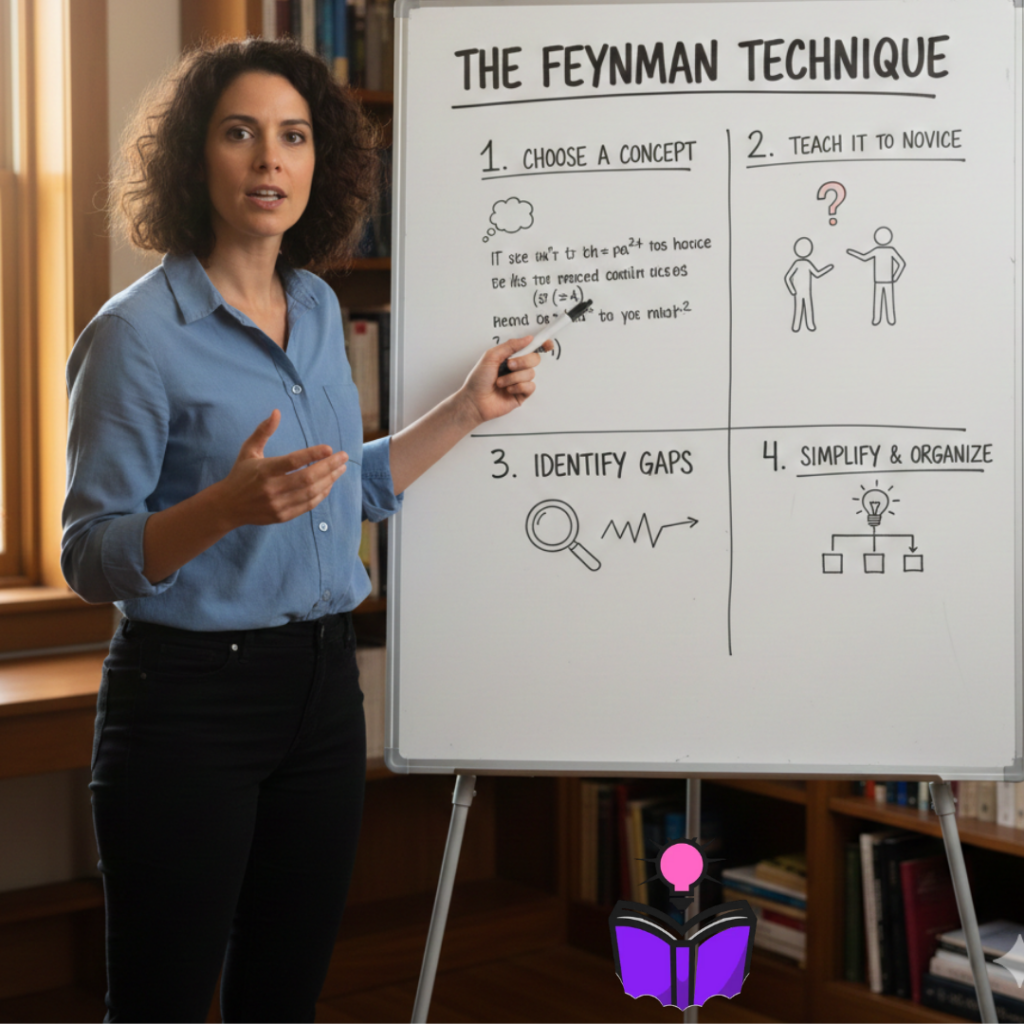
Step-by-Step Guide Technique0
Step 1: Choose a Topic
Pick one specific concept—not an entire chapter.
Example: “Photosynthesis” instead of “Biology.”
Focused topics produce faster results.
Step 2: Explain It in Simple Language
Pretend you’re teaching the topic to:
- A younger student
- Someone with no background knowledge
Use plain words. No jargon. No copying definitions.
If you get stuck—that’s the suspenseful moment. It means you’ve found a weak spot.
Step 3: Identify What You Don’t Understand
Every pause, confusion, or vague explanation reveals a gap.
Write those gaps down.
This step alone saves hours by showing you exactly what needs review.
Step 4: Go Back and Learn Only What’s Missing
Return to your notes or textbook—but with purpose.
You’re no longer studying everything.
You’re studying only what you don’t understand.
This is where time optimization truly happens.

Step 5: Simplify and Teach Again
Re-explain the topic in even simpler terms.
Use examples, analogies, or real-life comparisons.
If you can explain it smoothly and clearly—you’ve mastered it.
Why the Feynman Technique Works So Well
This technique forces your brain to:
- Organize information logically
- Translate ideas into your own words
- Connect concepts instead of memorizing facts
It turns learning into a problem-solving activity—making it more engaging and harder to forget.
Best Subjects for the Feynman Technique
The Feynman Technique works exceptionally well for:
- Science (physics, biology, chemistry)
- Math concepts and formulas
- History and social studies
- Programming and technical topics
- Exam revision and test preparation
Any subject that requires understanding—not just memorization—benefits from this approach.
How to Combine the Feynman Technique with Short Study Sessions
For even better results, use the Feynman Technique in 15–25 minute study blocks:
- 10 minutes explaining the concept
- 5 minutes identifying gaps
- 10 minutes reviewing and simplifying
This combination boosts focus and prevents burnout.
Common Mistakes to Avoid
To get the most out of the Feynman Technique, avoid:
- Copying textbook definitions
- Using complex terms to sound “smart”
- Skipping the gap-finding step
- Studying multiple topics at once
Simplicity is the secret.
Tools You Can Use (No Fancy Tech Required)
You can practice the Feynman Technique using:
- A blank notebook
- A whiteboard
- Voice notes (explaining out loud)
- Teaching a friend or even an imaginary student
The method works because of thinking, not tools.
The Hidden Advantage: Confidence Under Pressure
Here’s the part most students don’t expect.
When you study using the Feynman Technique:
- Exams feel familiar
- Questions feel easier
- Panic decreases
Why? Because you’re not recalling memorized lines—you’re understanding concepts.
That confidence is a game-changer.
How to Start Today (Even If You’re Short on Time)
Try this now:
- Pick one topic
- Explain it out loud in simple words
- Notice where you struggle
- Fix only those areas
One session is enough to feel the difference.
Final Thoughts: Learn Less, Understand More
The Feynman Technique proves that better learning doesn’t come from longer hours—but from deeper thinking.
If you want to optimize your study time, improve understanding, and actually remember what you study, this method is your secret weapon.
Start explaining.
Start simplifying.
And watch your study time shrink—while your results grow.
Ready to study smarter?
Save this guide and use the Feynman Technique in your next study session—you’ll never study the same way again.